Atomic Aquatics
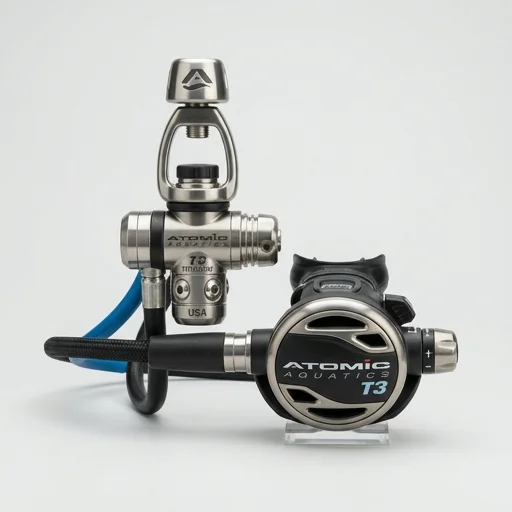
Atomic Aquatics T3
- Effortless breathing at depth
- Titanium corrosion resistance
- Sealed for cold water
As an Amazon Associate we earn from qualifying purchases.
Apeks built the Black Ice for water cold enough to freeze an ordinary regulator open: sealed diaphragm, thermal coating, heat-exchanger body.
| First Stage Type | Environmentally sealed diaphragm |
|---|---|
| Mounting Options | DIN (300 bar) or INT/Yoke |
| Low Pressure Ports | 5 |
| High Pressure Ports | 2 |
| Weight | approximately 900 grams (first stage only) |
| Operating Temperature Range | Below 10°C (50°F) recommended for cold water sealing benefits |
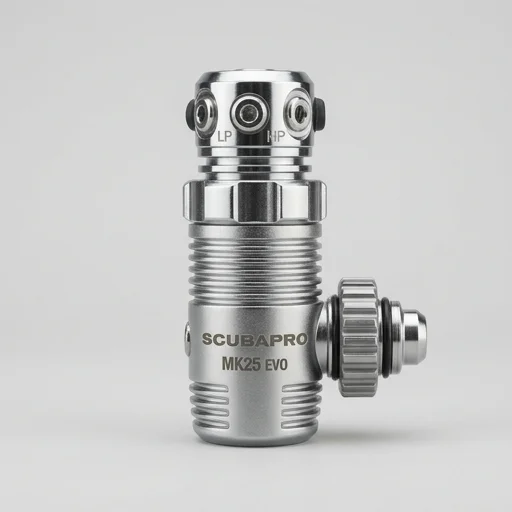
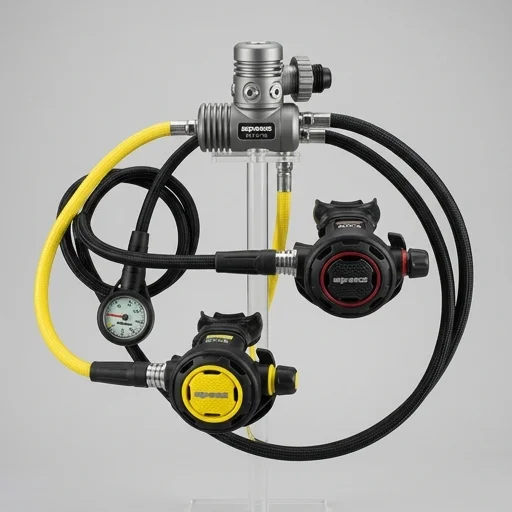
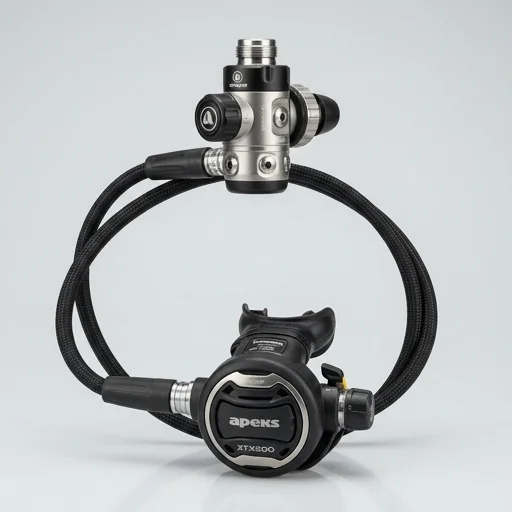
The Black Ice is an environmentally sealed over-balanced diaphragm first stage with a thermal coating designed to slow ice formation, rated for use below 10°C. At roughly 900 g for the first stage it is one of the lighter cold-water specialists, and five low-pressure plus two high-pressure ports leave room for a drysuit hose and a full console. DIN 300 bar and INT yoke are both available.
Free-flow from internal icing is the failure mode that ends cold-water dives, and the Black Ice attacks it from three directions: a sealed diaphragm, a heat-exchanger first stage body, and a thermal coating. Everything else follows from that priority. If you dive under ice, in springs or in cold northern water, this is a purpose-built tool. If you dive the tropics, you are paying for insurance you will never claim.
Apeks designed the Black Ice around one specific problem. In near-freezing water, expanding gas chills the first stage until moisture inside it freezes, and a frozen regulator free-flows. The Black Ice answers this with an environmentally sealed diaphragm that keeps water out of the mechanism entirely, a heat-exchanger body that sheds heat more effectively, and a thermal coating that slows ice formation on the exterior. Apeks recommends it specifically for water below 10°C, and that recommendation is the whole design brief.
The over-balanced diaphragm keeps intermediate pressure climbing gently with depth, so airflow holds up at the deep end of a dive rather than tightening. The second stage is high-flow with an adjustable venturi control, and the balanced valve keeps delivery even as tank pressure falls. An over-moulded case protects the second stage housing from the knocks that come with ice holes, wreck interiors and rocky entries, and the exhaust tee is shaped to push bubbles clear of the mask rather than across it.
Rigging flexibility is unusually good for a cold-water regulator: five low-pressure ports and two high-pressure ports handle a drysuit inflator, an alternate air source and instrumentation without forcing awkward hose angles. Marine-grade brass under chrome plating handles saltwater, silt and mineral-heavy spring water through repeated service cycles. The trade-offs are the familiar ones for the category — higher price, more weight than a minimalist travel set, and servicing that costs more because the sealing components are specialised. Warm-water-only divers should buy something else.