Atomic Aquatics
Atomic Aquatics T3
- Effortless breathing at depth
- Titanium corrosion resistance
- Sealed for cold water
As an Amazon Associate we earn from qualifying purchases.
Metal-free second stage construction, dual heat exchangers and a five-port swivelling turret — Atomic's answer to corrosion and jaw fatigue.
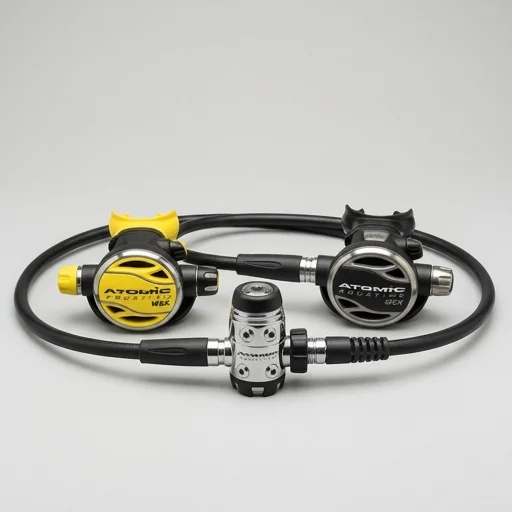
| First Stage Type | Sealed balanced diaphragm |
|---|---|
| Second Stage Type | Servo-preorifice pneumatically balanced |
| Weight | 1.2 kg (2.6 lbs) |
| Low Pressure Ports | 5 ports |
| High Pressure Ports | 2 ports |
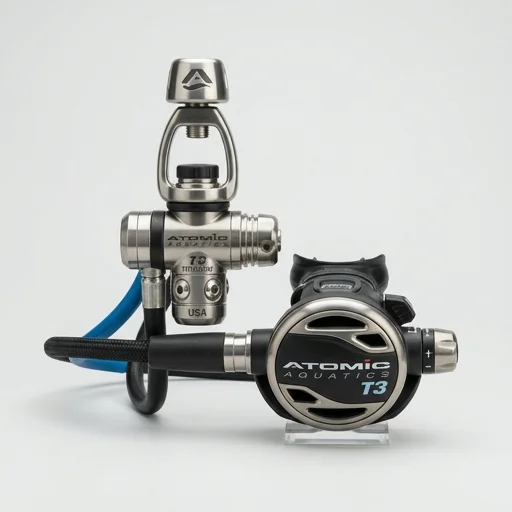
The WSX runs a sealed balanced diaphragm first stage with dual heat exchangers and a swivelling turret carrying five low-pressure and two high-pressure ports. The servo-preorifice second stage is boot-mounted and built without metal in the housing, which removes both corrosion and metal fatigue from the failure list. At 1.2 kg it is the heaviest regulator in this shortlist.
Two design decisions define the WSX. Metal-free second stage construction removes corrosion and fatigue as long-term concerns, and the servo-preorifice valve makes the first breath as easy as the last at any depth. The swivelling five-port turret solves hose routing better than fixed-port first stages. It is bulky and it needs an Atomic-certified technician, but maintenance demands are genuinely lower than traditional metal regulators.
The WSX first stage is a sealed balanced diaphragm with dual heat exchangers, which is Atomic's standard answer to cold water: keep the mechanism dry and give it enough thermal mass to resist icing. The sealed chamber blocks silt, sand and cold-water intrusion, so murky lakes, kelp beds and alpine sites do not degrade performance. What sets it apart from the rest of the category is the turret — it swivels, and it carries five low-pressure and two high-pressure ports, so hoses find natural angles instead of being forced into them.
The second stage uses a servo-preorifice pneumatically balanced design, which is the reason divers describe breathing on it as effortless at any depth or demand level. It is boot-mounted to shift weight off the jaw over long dives, and the housing avoids metal entirely, which removes both saltwater corrosion and metal fatigue from the list of things that eventually kill a second stage. The oversized purge button clears quickly with gloved hands, and the exhaust is angled to sweep bubbles out of the field of view.
The costs are weight and access. At 1.2 kg this is the heaviest regulator in this group and its profile is bulkier than a minimalist travel set, so it is the wrong choice if your dive bag lives on aircraft. Atomic's service network is smaller than the mass-market brands, so the occasional specialised service needs planning. In exchange, maintenance requirements are lower than traditional metal regulators, and the corrosion resistance is real rather than a coating that eventually wears through.