Atomic Aquatics
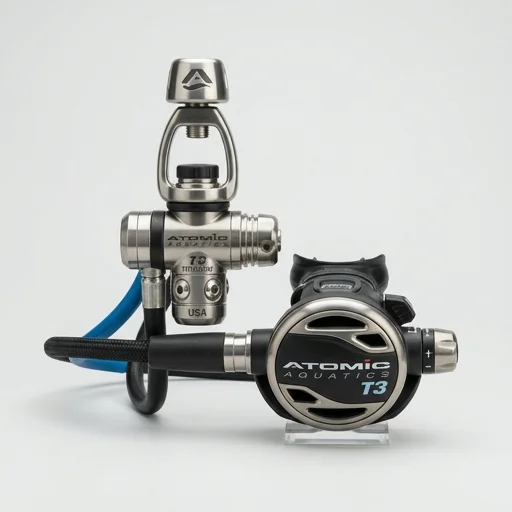
Atomic Aquatics T3
- Effortless breathing at depth
- Titanium corrosion resistance
- Sealed for cold water
As an Amazon Associate we earn from qualifying purchases.
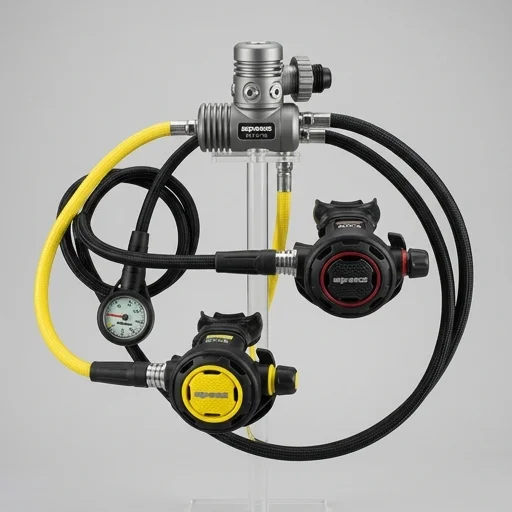
Apeks' flagship: an over-balanced sealed diaphragm first stage feeding a second stage you can tune mid-dive with gloves on.
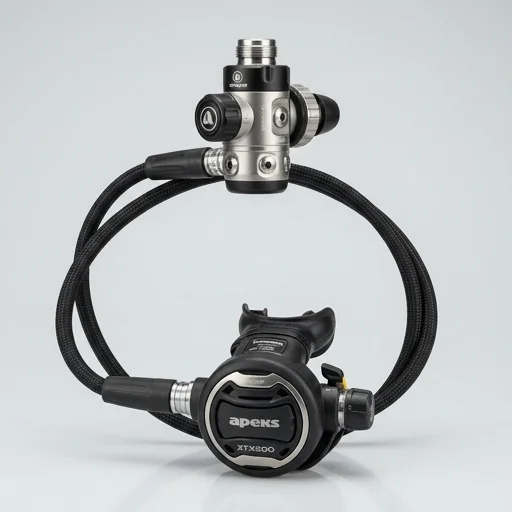
| First Stage Type | Environmentally sealed, over-balanced diaphragm |
|---|---|
| Low-Pressure Ports | 4 |
| High-Pressure Ports | 2 |
| Weight | approx. 1,100 g |
| Depth Rating | Recreational and technical diving to standard limits (per certification) |
The XTX200 pairs an environmentally sealed, over-balanced diaphragm first stage with a compact second stage carrying both an adjustable inhalation effort control and a diver-operated venturi lever. It weighs roughly 1100 g and offers four low-pressure and two high-pressure ports. Apeks' commercial and military heritage is the reason it turns up on technical rigs as often as recreational ones.
Two adjustments — inhalation effort and venturi — let you match the regulator to the dive instead of accepting one fixed breathing character, and the pivoting hose connection keeps the second stage sitting naturally. The sealed first stage handles silt, cold and contaminated water. It is not light, the exhaust tee is bulky to some divers, and several report a break-in period before it breathes at its best.
The XTX200's first stage is over-balanced and ambient-pressure balanced, holding intermediate pressure constant while raising it slightly with depth, so airflow strengthens exactly where demand peaks. Environmental sealing keeps silt, sand and cold water out of the mechanism, which is why the regulator survives murky quarry water and near-freezing conditions that cause unsealed designs to free-flow. Port count is practical rather than showy: four low-pressure and two high-pressure ports cover a primary, an alternate, an inflator and a console without awkward routing.
What separates the XTX200 from cheaper Apeks models is control. The second stage carries a diver-adjustable inhalation effort knob and a venturi lever that prevents surface free-flow, and the pivoting hose connection lets the second stage find a natural angle in the mouth rather than pulling to one side. The purge button is large enough to work with thick gloves. Over-moulded rubber housing adds durability and grip, and a chrome-plated brass first stage body handles years of saltwater exposure and repeated servicing.
The criticisms are consistent and worth taking seriously. It is not a travel regulator — around 1100 g and a bulky exhaust tee are the price of the construction. Environmental sealing needs a technician who knows the system, so servicing is less casual than a simple unsealed first stage. And a number of divers report that the breathing character sharpens after the first few dives rather than out of the box. Past that break-in, the XTX200 is the regulator Apeks is judged by.